


WHICH THREAD TO CHOOSE FOR SEWING LEATHER?
Please note that all this information is provided for guidance only and there are no "right answers": everyone must gain their own experience.
The larger your item, the wider the stitch spacing will be, and the thicker the thread will be. Commonly, the most used thread diameter for hand-sewing leather (saddle stitch) is:
- For leather goods (handbags, satchels, etc.):
632 – Fil Au Chinois / M50 – MeiSi - 0.55 mm diameter thread
or 432 – Fil Au Chinois / M60 – MeiSi - 0.65 mm diameter thread - For small leather goods (card holders, wallets, etc.):
832 – Fil Au Chinois / M40 – MeiSi - 0.45 mm diameter thread
or 632 – Fil Au Chinois / M50 – MeiSi - 0.55 mm diameter thread
The table below shows the approximate thread equivalences:
| Thread Diameter | MeiSi | Fil Au Chinois (Linen Thread) |
Fil Au Chinois (Leather Goods Spc.) |
Coats Barbour (Linen Thread) |
Polyester Thread (SERAFIL Type) |
Braided and waxed polyamide thread |
| 0.29 mm | No. 60 | |||||
| 0.35 to 0.38 mm | M30 | 28/2 | No. 40 | |||
| 0.41 to 0.45 mm | M40 | 832 | 28/3 | No. 30 | ||
| 0.50 to 0.52 mm | 632 | 28/4 | 18/2 | No. 20 | ||
| 0.55 to 0.58 mm | M50 | 532 | 25/3 | No. 16 | ||
| 0.60 to 0.65 mm | M60 | 432 | 18/3 | X | ||
| 0.69 to 0.70 mm | 18/4 | |||||
| 0.75 to 0.80 mm | M70 | 332 | 18/5 | No. 8 | X | |
| 0.90 to 1.2 mm | M90 | 18/7 | X |
WHICH THREAD AND NEEDLE TO CHOOSE FOR MACHINE SEWING?
WHICH NEEDLE TO CHOOSE FOR MACHINE SEWING LEATHER?
For machine sewing leather, we recommend using special leather machine needles. These needles, very rigid, are made of hardened steel to prevent breakage when sewing thick materials.
WHICH NEEDLE TO CHOOSE FOR HAND SEWING LEATHER?
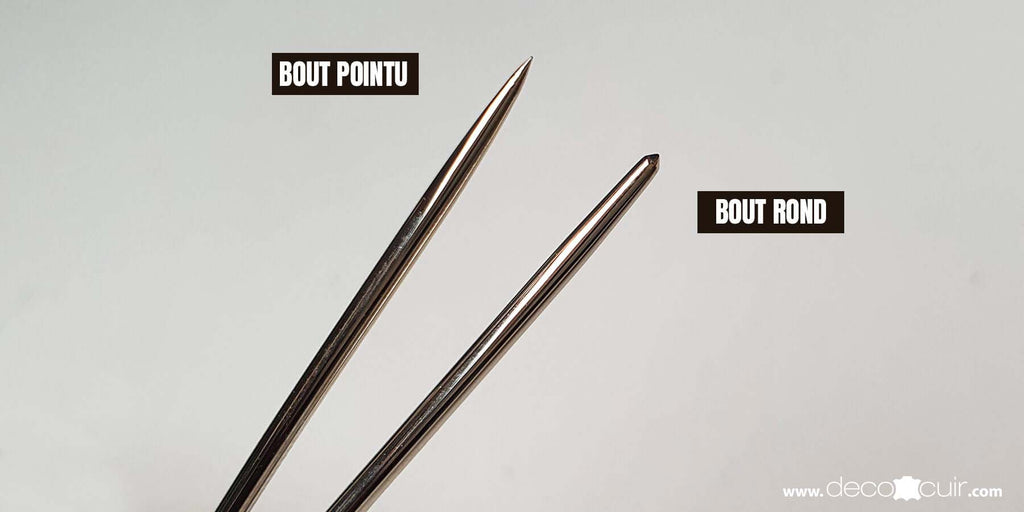
The round-tipped needle is the "standard" needle for sewing thick leathers and especially for saddle stitching. The tip is round to avoid pricking your fingers or scratching the leather during sewing. The tip does not need to be sharp because the leather is pre-pierced with an awl (diamond awl). To learn more about saddle stitching, we invite you to read our article:
The sharp-tipped needle is used for sewing thin leathers: it allows you to pierce the leather directly. It is better to use a round-tipped needle to avoid damaging the leather during sewing.
WHICH NEEDLE TO CHOOSE BASED ON THREAD DIAMETER?
Below is a summary table of the compatibilities between our round-tipped needles for leather sewing and the different thread diameters.
| Needles | M30 28/2 |
M40 832 28/3 |
632 28/4 18/2 |
M50 532 25/3 |
M60 432 18/3 |
18/4 BRAIDED POLY THREAD |
M70 332 18/5 |
M90 18/7 & BRAIDED POLY THREAD |
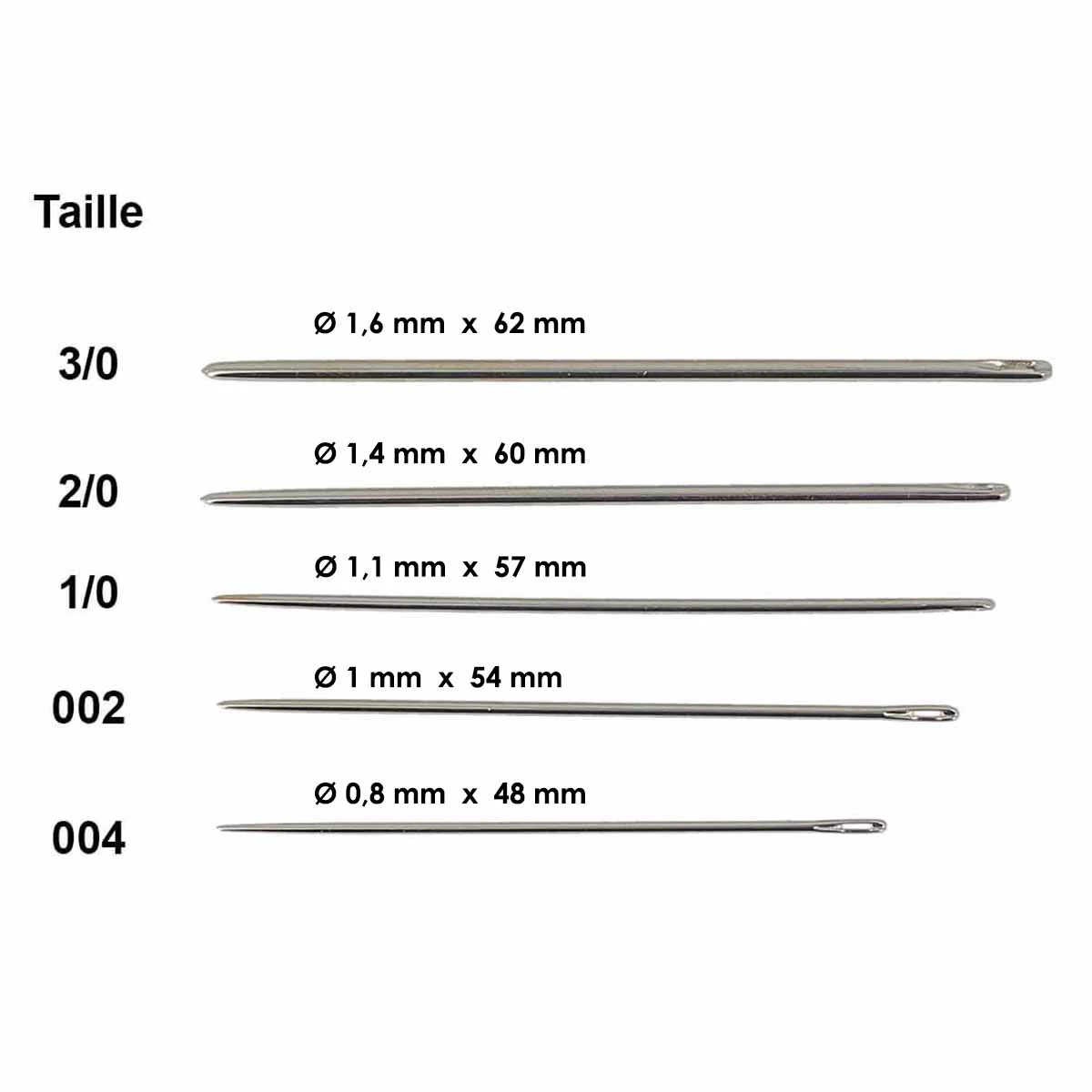
| Ø 0.36 mm | Ø 0.43 mm | Ø 0.51 mm | Ø 0.57 mm | Ø 0.63 mm | Ø 0.70 mm | Ø 0.78 mm | Ø 1 mm | |
| Size 004 – 953 No. 05 Ø 0.8 mm - Lg = 48 mm |
++ | ++ | + | - | - | - | - | - |
| 953 no. 03 Ø 0.9 mm - Lg ≈ 54 mm |
++ | ++ | + | - | - | - | - | - |
| Size 002 – 953 no. 02 Ø 1.0 mm - Lg ≈ 55 mm |
+ | + | ++ | ++ | + | - | - | - |
| Size 1/0 Ø 1.1 mm - Lg = 57 mm |
+ | + | + | ++ | ++ | + | - | - |
| 953 no. 01 Ø 1.1 mm - Lg = 60 mm |
- | + | + | ++ | ++ | + | - | - |
| 952-2/0 Ø 1.3 mm - Lg = 70 mm |
- | - | + | + | ++ | ++ | + | - |
| Size 2/0 Ø 1.4 mm - Lg = 60 mm |
- | - | - | - | ++ | ++ | - | - |
| Size 3/0 Ø 1.6 mm - Lg = 62 mm |
- | - | - | + | + | ++ | + | + |
| 953 no. 4/0 Ø 1.4 mm - Lg = 80 mm |
- | - | - | + | ++ | ++ | + | - |
++ Perfectly suitable + Suitable - Not suitable
The reference needle (L3912) from Deco Cuir is size 002 / 953 no. 2: ⌀1 mm (internal reference: CA118_010 or CA123_010). You can use this needle for all your "standard" leather goods creations.
For fine stitches, especially for creating small leather goods, we recommend needle size 004 / 953 no. 05: ⌀0.8 mm (internal reference: CA118_008 or CA123_008), which means for thread diameters between 0.36 mm and 0.51 mm.
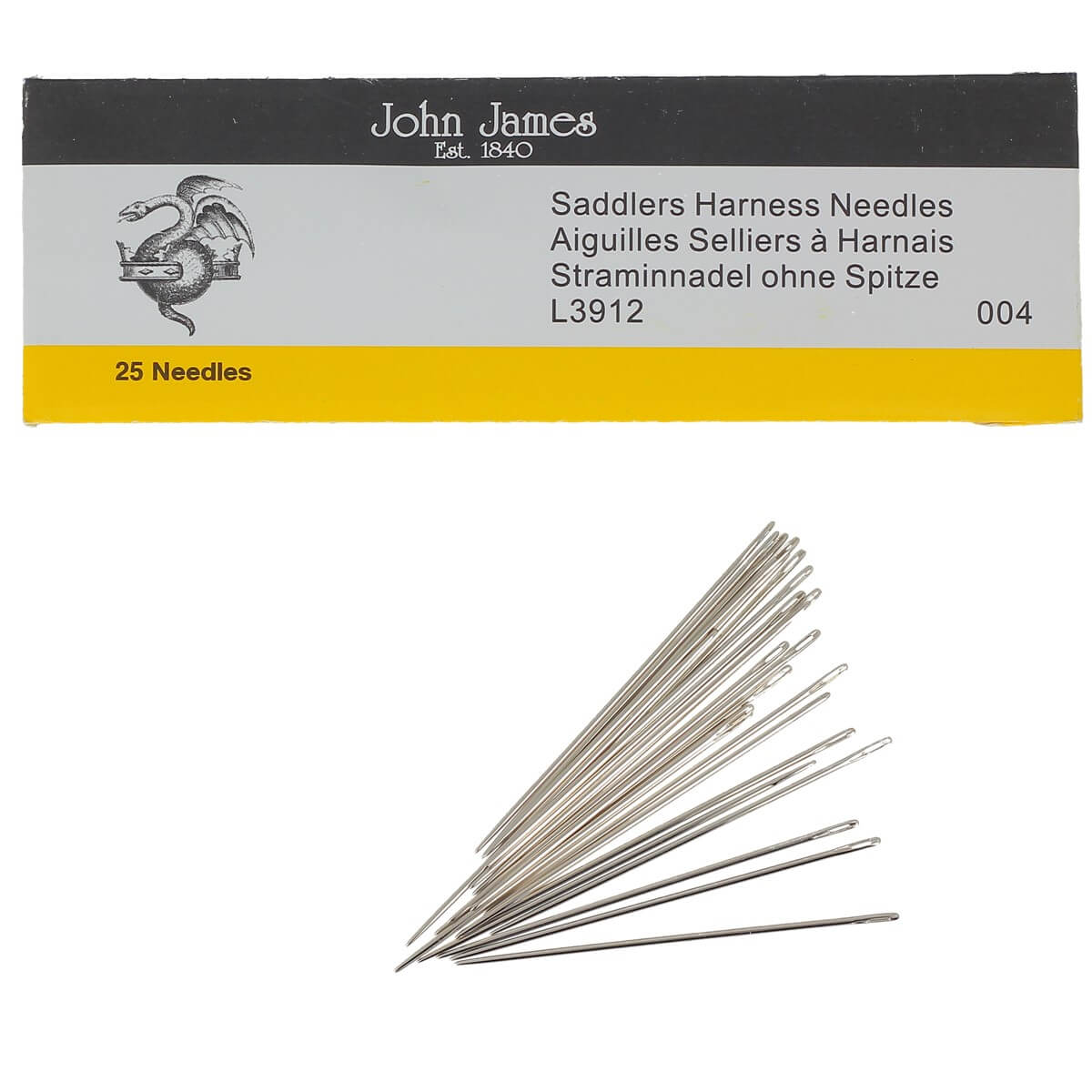
JOHN JAMES BRAND NEEDLES

WHICH PRONG SPACING AND THREAD TO CHOOSE ACCORDING TO YOUR CREATION?
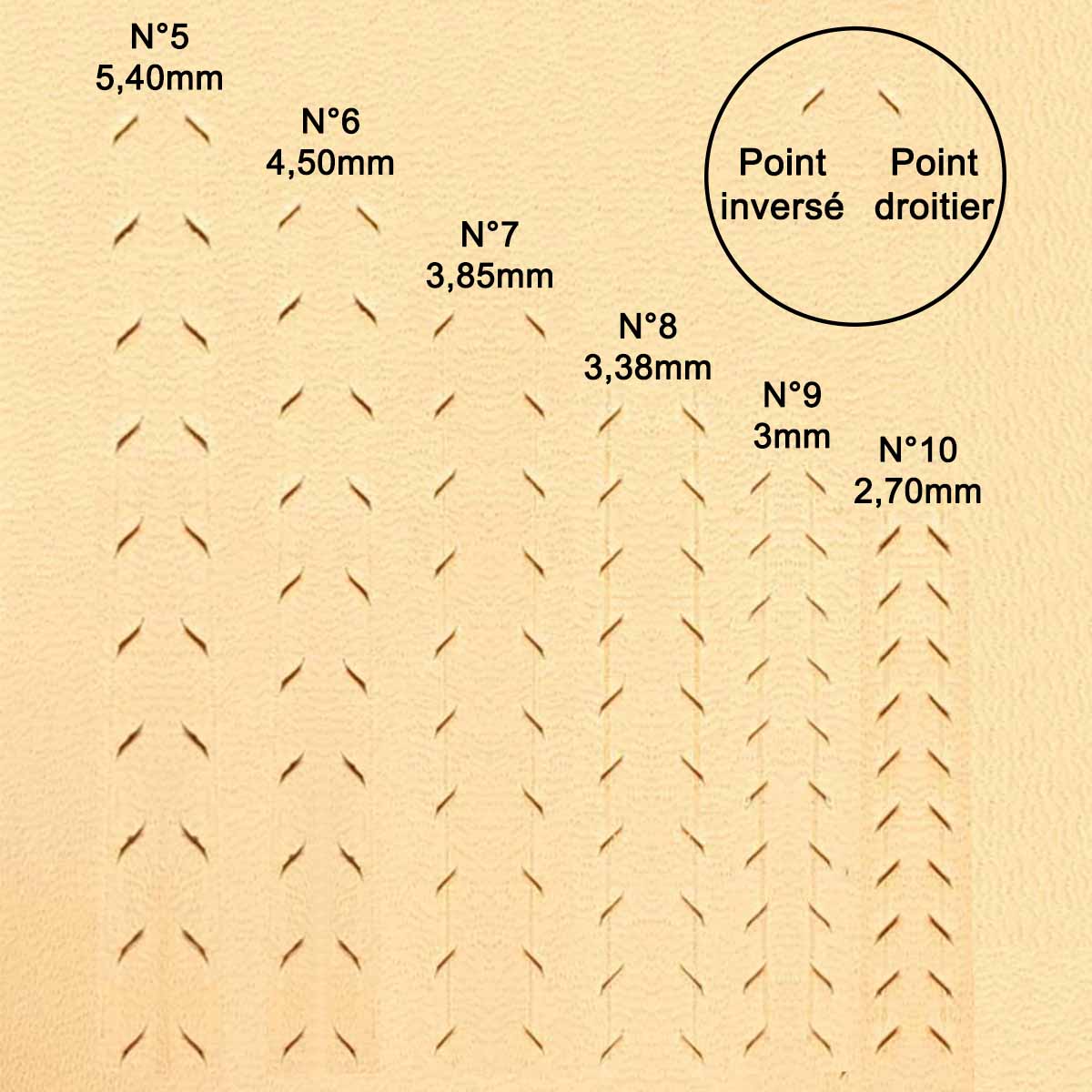
The prong spacing (distance between the center of 2 prongs) ranges from 2.25 mm to 6.75 mm, thus meeting different needs. The higher the number of the pricking iron, the smaller the spacing, so the stitches will be tighter. The prong spacing should be chosen according to the item you wish to create. The different combinations of prong spacing / thread diameter give different aesthetic results: it's up to you to choose!
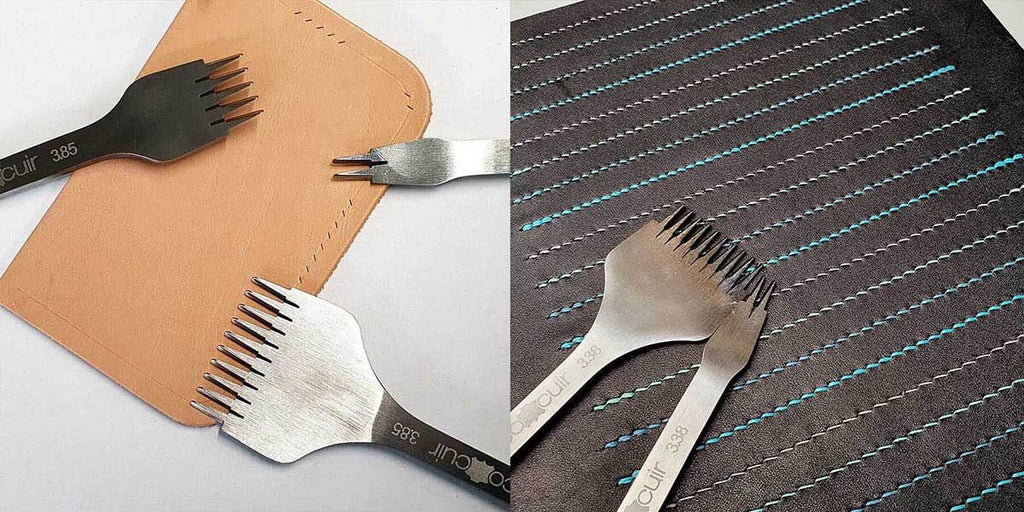
| Leather Item | Total leather thickness | Prong spacing | Thread diameter |
| Small item (e.g. bookbinding, small leather goods) | Max. 2.5 mm | 2.5 to 3.38 mm | 0.30 to 0.53 mm |
| Medium item (e.g. leather goods) | Max. 4 mm | 3.38 to 3.85 mm | 0.54 to 0.70 mm |
| Large item (e.g. upholstery, saddlery, luggage) | Max. 7 mm | 4 to 6.75 mm | 0.76 to 1.30 mm |
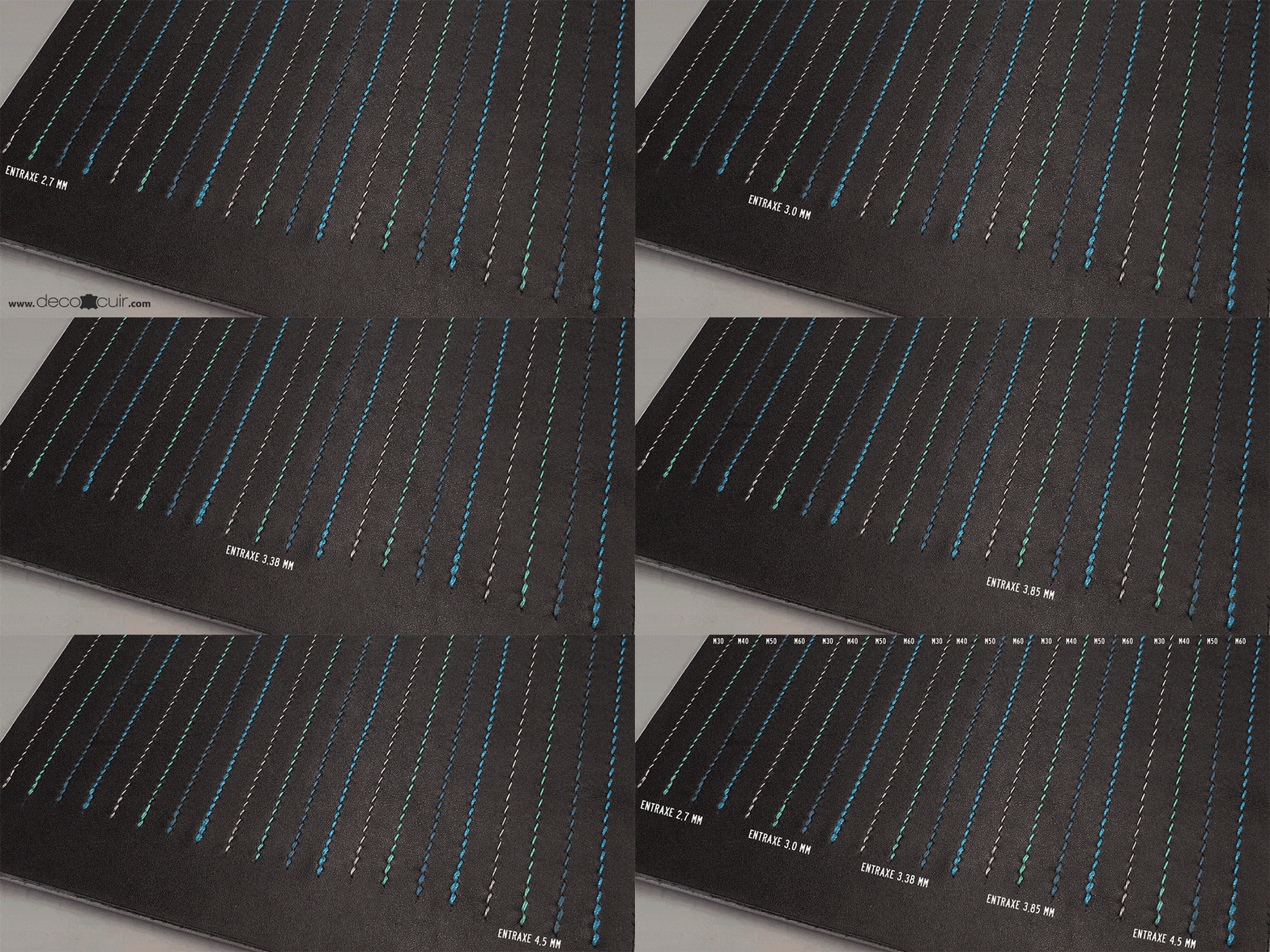
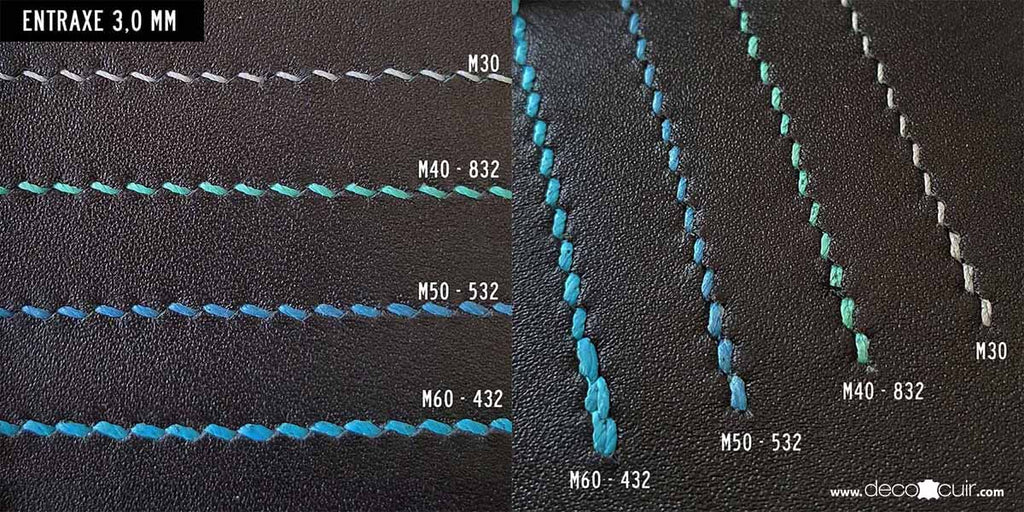
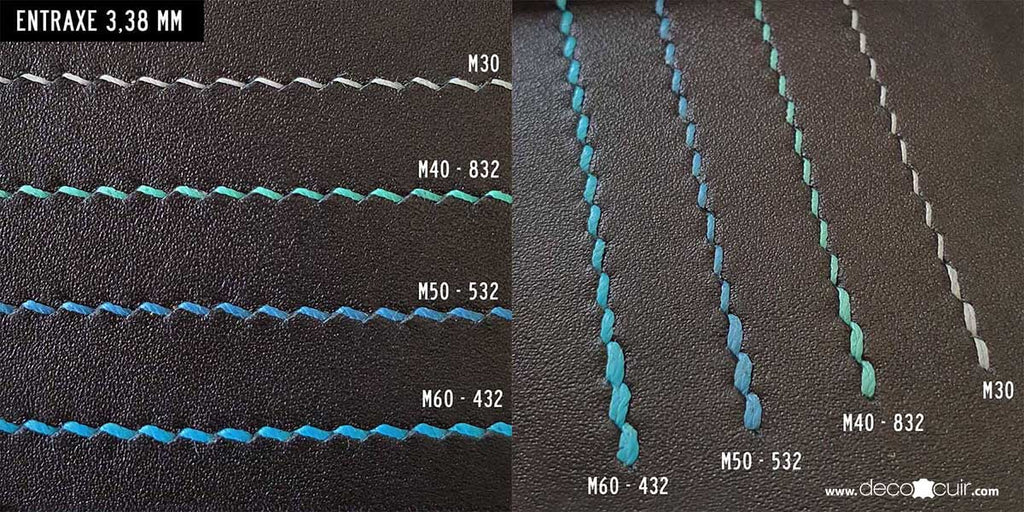
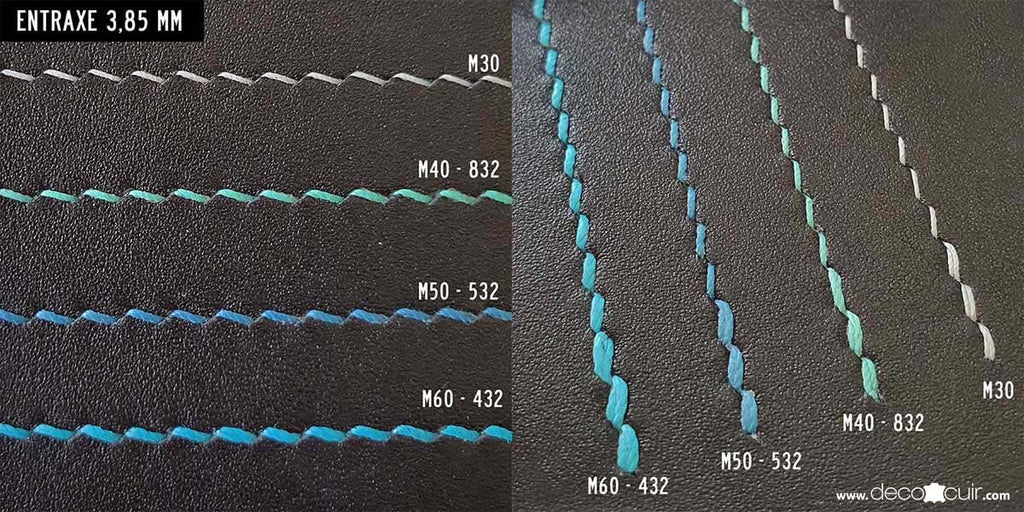
This table is given as a guide only; we invite you to look at the images below to form your own opinion. The "standard" for leather goods creations is a 3.38 mm spacing - no. 8 (3 stitches per centimeter).
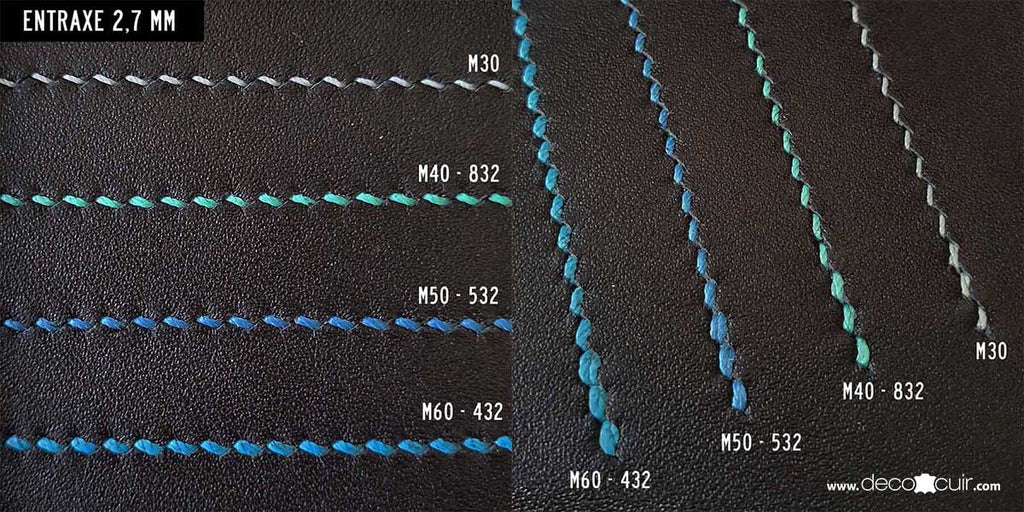
You will see the result of 4 thread diameters on 5 different stitch widths (2.7 - 3.0 - 3.38 - 3.85 and 4.5 mm).
- M30: Ø 0.35 mm
- M40 - 832: Ø 0.45 mm
- M50 - 532: Ø 0.55 mm
- M60 - 432: Ø 0.65 mm

WHICH THREAD MATERIAL FOR WHICH TYPE OF LEATHER CREATION?
For leather sewing, 2 types of threads are mainly used: polyester thread (synthetic) or linen thread.

Traditionally, linen thread is used for making leather goods: a 100% natural thread. Linen thread is ideal for hand sewing leather. It is important to know that throughout the life of your leather item, the thread will wear out (mainly due to friction): unlike synthetic thread which will cut the leather, linen will tear. It will therefore be easier to re-sew the leather piece than to repair a cut.
For saddlery and harness making, we recommend using waxed linen thread: the wax strengthens and waterproofs the thread, making it resistant to the aggressions of time and humidity. You can also choose waxed braided polyester thread, knowing that polyester thread is rot-proof.
Polyester thread, on the other hand, is widely used for machine sewing leather.
WAXED, PITCHED OR GLAZED THREAD: WHAT ARE THE DIFFERENCES?
Waxed thread: the thread fibers have been glued together with beeswax. The wax facilitates the thread's glide when sewing, prevents knots, and protects the thread during sewing and throughout the life of your creations. Before each sewing, we recommend waxing your linen thread with a block of beeswax. Feel free to cut your wax block in half so that it remains "clean" for hot edge work.
Pitched thread: Pitch is a sticky substance obtained by distilling pine resin derivatives. Synthetic pitch also exists. As mentioned earlier, pitch strengthens and waterproofs the thread, making it resistant to the aggressions of time and humidity (perfect for saddlery, harness making, or horse tack). The thread is rot-proof.
Glazed thread: during its manufacture, the thread is passed through a starch bath to which beeswax has been added. This technique helps protect the thread during sewing.
TWISTED, CABLED, CARDED OR BRAIDED THREAD: WHAT ARE THE DIFFERENCES?
 |
 |
|
Twisted thread: |
Cabled thread: |
 |
 |
|
Carded thread: |
Braided thread: |




11 comments
Dupuy
Hautement interessant.mille mercis..
Michel.
Deco Cuir
Bonjour,
Nous vous remercions pour votre commentaire sur notre blog ! Si vous recherchez un fil haut de gamme pour la couture du cuir à la machine je vous conseille le fil polyester coton de la marque française AU CHINOIS en 0,38 mm de diamètre : https://www.decocuir.com/collections/fil-au-chinois-polyester-coton-28-2-france Nous vendons des bobines de 50 m. Le fil polyester tressé et ciré n’est pas conseillé pour ce type de couture. Le fil « standard » utilisé pour la couture du cuir à la machine est le fil 100 % polyester : https://www.decocuir.com/collections/fil-polyester-n30
N’hésitez pas à aller voir notre guide sur la couture du cuir à la machine : https://www.decocuir.com/blogs/blog-tutoriel-patron-cuir/comment-coudre-cuir-machine
Bonne journée,
L’équipe Deco Cuir
Fanny
Bonjour,
un grand merci pour votre site, j’ai beaucoup de plaisir à découvrir votre savoir faire.
J’ai une petite question. Quel fil conseiller vous pour un produit de maroquinerie haut de gamme, ( machine à coudre) un fil ultra resistant, recyclé peut être ? le fil polyester tressé ciré ne serait il pas un peu épais pour ce type de travail ? qu’en pensez vous ? qu’est ce qui vous semble le plus esthétique et durable possible ?
je vous remercie et vous souhaite un bon weekend
fanny
Plassard Muriel
Cet article est très intéressant pour moi, j’ai bien compris la différence entre les différents fils.
Nadine sereng
bonjour, je trouve vos conseils très utiles ……je reviens vers vous très vite pour une nouvelle commande, après avoir fais le point sur le matériel qui me sera nécessaire…merci
M.GECKO
Bonjour,
C’est un vrai plaisir de parcourir ce site qui me rappelle plein de bon souvenirs étant fils de bourrelier et ayant travaillé quelques temps ce beau matériau avec de vieux outils qui sont aujourd’hui remis au goût du jour avec une qualité remarquable.
Je suis passé au magasin pour acheter une peau et réaliser 2 tabliers pour faire des cadeaux….
Je viens de réaliser une pince à coudre sur table (en merisier de récupération ) en plus de ma vieille pince et je compte bien refaire des articles de cuir avec plaisir.
Bravo déco cuir !
Michel
isabelle Michaud-Soret
Merci, ces informations sont très intéressantes pour s’y retrouver dan sle choix des fils, des entraxes et des aiguilles
Jacob.c
Bonjour
Merci pour toutes les informations pratiques.
Je me renseigne avant de me lancer.🤞
Anonymous
Je vous trouve géniaux, merci pour toutes vos informations très utiles,
j’ai créée des tabliers en cuir et je suis fan de votre site!!!
Anonymous
Merci beaucoup ! J’ai appris des trucs !
On arrête pas d’apprendre en fait !
Anonymous
Merci beaucoup pour toutes ces informations, très précieuses pour l’absolue néophyte que je suis !